

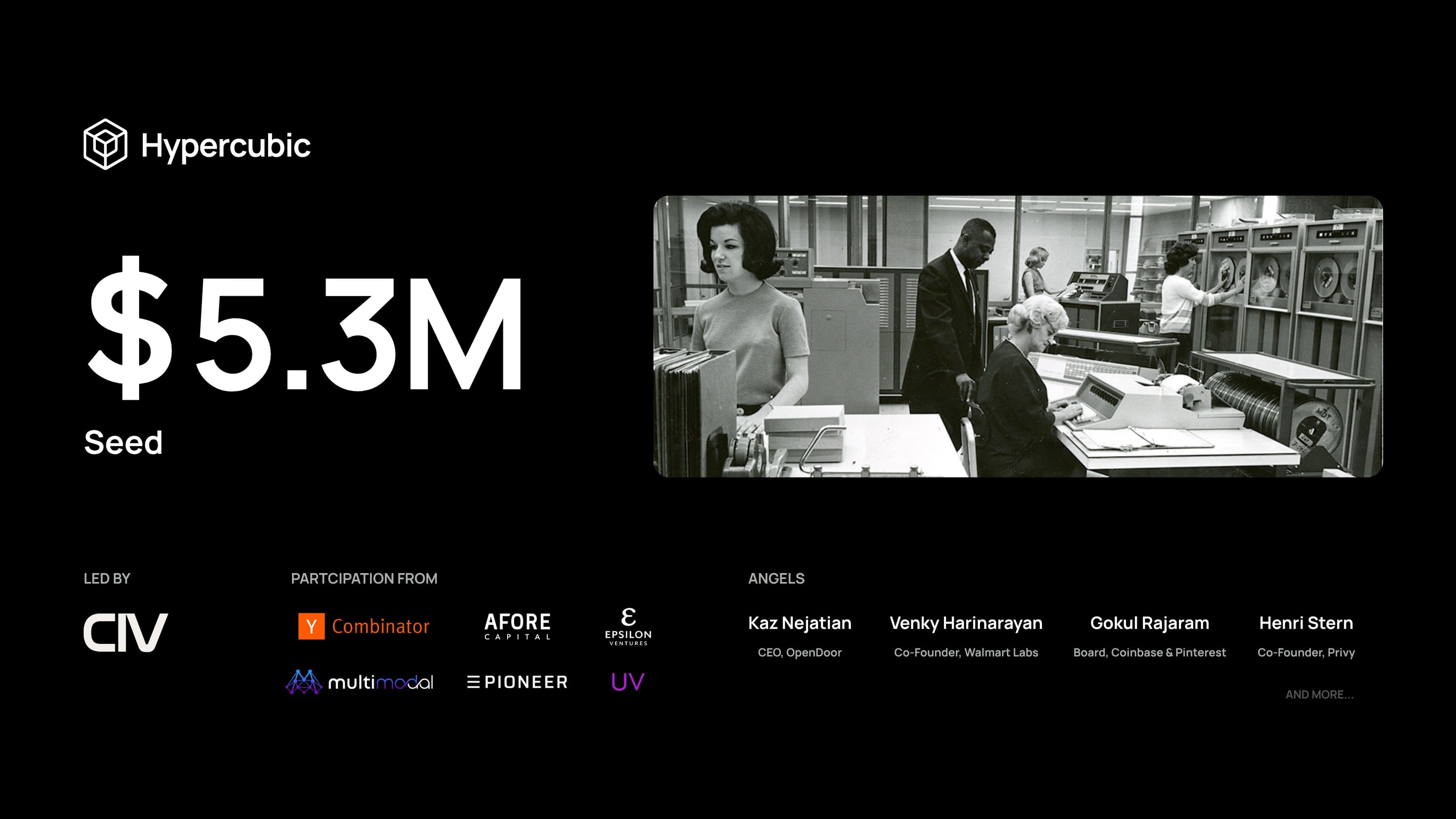
Today, we’re announcing that Hypercubic has raised $5.3 million in seed funding, led by CIV.
Reasoning models can now understand and manipulate software at a scale that would have sounded absurd only a few years ago. Over the past year, we’ve made several breakthroughs in the infrastructure required to apply that capability to some of the oldest and most critical software in the world running on mainframes.
There is a rare window right now to redefine how that software gets rebuilt.
The Pressure to Modernize
Mainframes still run critical systems across banks, insurers, governments, airlines, retailers, and some of the largest enterprises in the world. Over decades, these applications have accumulated enormous amounts of business logic, operational knowledge, and edge cases.
And in many cases, nobody fully understands them anymore.
The pressure to modernize is increasing. Mainframe experts are retiring, operating costs remain high, and enterprises need to ship products faster. A bank constrained by a legacy stack might take a year to launch a new credit-card product while a competitor on a modern stack ships in months. At scale, that difference can mean a billion dollars is lost revenue.
Replacing these systems is extraordinarily difficult.
A modernization program can become a decade-long roadmap involving dozens of engineers and tens of millions of dollars. Teams must reconstruct how the existing application behaves, recover undocumented business logic, rebuild it, migrate data, and prove the replacement is safe, all without interrupting the business.
Historically, humans have had to carry almost all of that work which made it a labor intensive process.
For the first time, it is plausible to ask: How much of a multi-year mainframe modernization program can become software?
A New Model for Mainframe Modernization
Our thesis is simple: mainframe modernization should become a repeatable, software-driven process rather than a bespoke human undertaking.
At Hypercubic, we’re building the most capable mainframe modernization platform in the world, one that is able to understand, rebuild, and verify critical systems at high velocity.
We started Hypercubic almost a year ago. In that short period, our small team has repeatedly pushed the frontier of what we thought was technically possible. We’re already seeing with customers how our platform can compress parts of the modernization lifecycle to something that is dramatically faster, cheaper, and more reliable than what enterprises have historically believed is possible.
There is an enormous amount of mission-critical legacy software in the world running on mainframes. Much of it will eventually need to be understood, transformed, or replaced.
Today, doing that is treated as a massive human undertaking. We think that work can become fundamentally computational instead.
If we are right, Hypercubic can become the machinery through which a meaningful fraction of the world's critical software is rebuilt.
“I have seen several major technology shifts up close, and the most valuable opportunities are often nonobvious and hide in markets the broader technology industry has overlooked,” said Venky Harinarayan, co-founder of Epsilon Ventures and a creator of Walmart Labs. “Mainframe modernization is a deeply unglamorous market, which is precisely why so few software companies have gone far enough into it. Hypercubic is entering a massive, long-neglected space with real demand, little noise, and the opportunity to turn a services industry into a new category of enterprise software.”
Backed by World-class Investors
We’re grateful to be backed by an incredible group of investors. The round was led by CIV, with participation from Y Combinator, Afore Capital, Multimodal Ventures, Pioneer Fund, Epsilon Ventures, Unpopular Ventures, and others, alongside our angels including Kaz Nejatian (CEO, Opendoor), Venky Harinarayan (Co-Founder, Walmart Labs), Gokul Rajaram (Board, Coinbase & Pinterest), Henri Stern (Co-Founder, Privy), Tony Dang (Co-Founder, Infisical), Mike Hinckley, Ryan Bednar, Ben Bryant, Youcef Es-skouri, and more.
We’re building a small, high-caliber team to go after this. If this problem excites you, please reach out, we’re hiring exceptional people across the team!
You can view our open roles here or learn more at hypercubic.ai/careers
Related insights
Code Comprehension at Scale: Learning from the Bitter Lesson
Handcrafted tricks break at scale. The future of code comprehension lies in holistic, learning-based systems.
The Lindy Effect and COBOL: Why a 65-Year-Old Language Runs the World
You might think that legacy languages like COBOL are dying, but they're not going anywhere.
HyperLoop: A Verification-Driven System for Mainframe Modernization
HyperLoop modernizes COBOL applications with AI and layered verification to preserve legacy behavior safely.
Introducing Hopper: An Agentic Development Environment for the Mainframe
Hopper is an agentic development environment for the mainframe that lets AI agents operate directly across TN3270, ISPF, JCL, JES, CICS, VSAM, datasets, jobs, spool output, and return codes.