

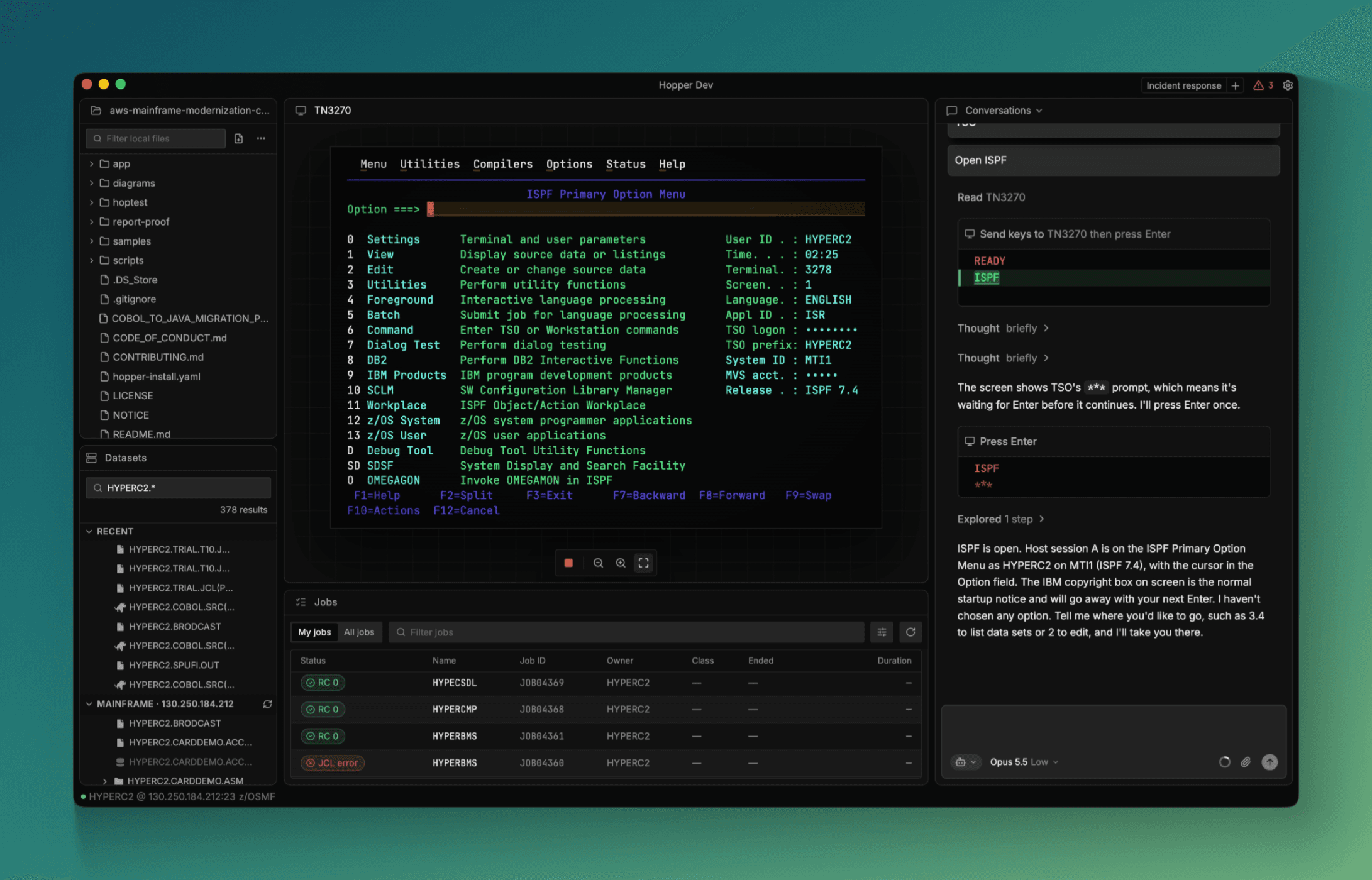
AI agents can now navigate large codebases, implement changes, execute tests, investigate failures, and carry out increasingly complex development workflows. What previously required hours of manual effort can increasingly be delegated to agents working directly inside the development environment.
But bringing these capabilities to the mainframe requires solving a fundamentally different problem.
Mainframe development is not simply about editing COBOL or writing JCL. It involves interacting with a live computing environment where source code, datasets, jobs, transactions, and system configurations are deeply interconnected.
When we introduced Hopper earlier this year, our goal was to make this environment accessible to AI agents.
We built a mainframe-native development environment where agents could navigate TN3270 sessions, inspect datasets, submit JCL, analyze JES output, interact with CICS, and execute real operations against z/OS.
Today, we're introducing Hopper 1.5, extending that foundation with deeper agent integration, automated incident investigation, and end-to-end CICS development workflows.
Hopper is evolving beyond an agentic terminal into a development environment where engineers and AI agents can work together across the mainframe software lifecycle.
What's new in Hopper 1.5
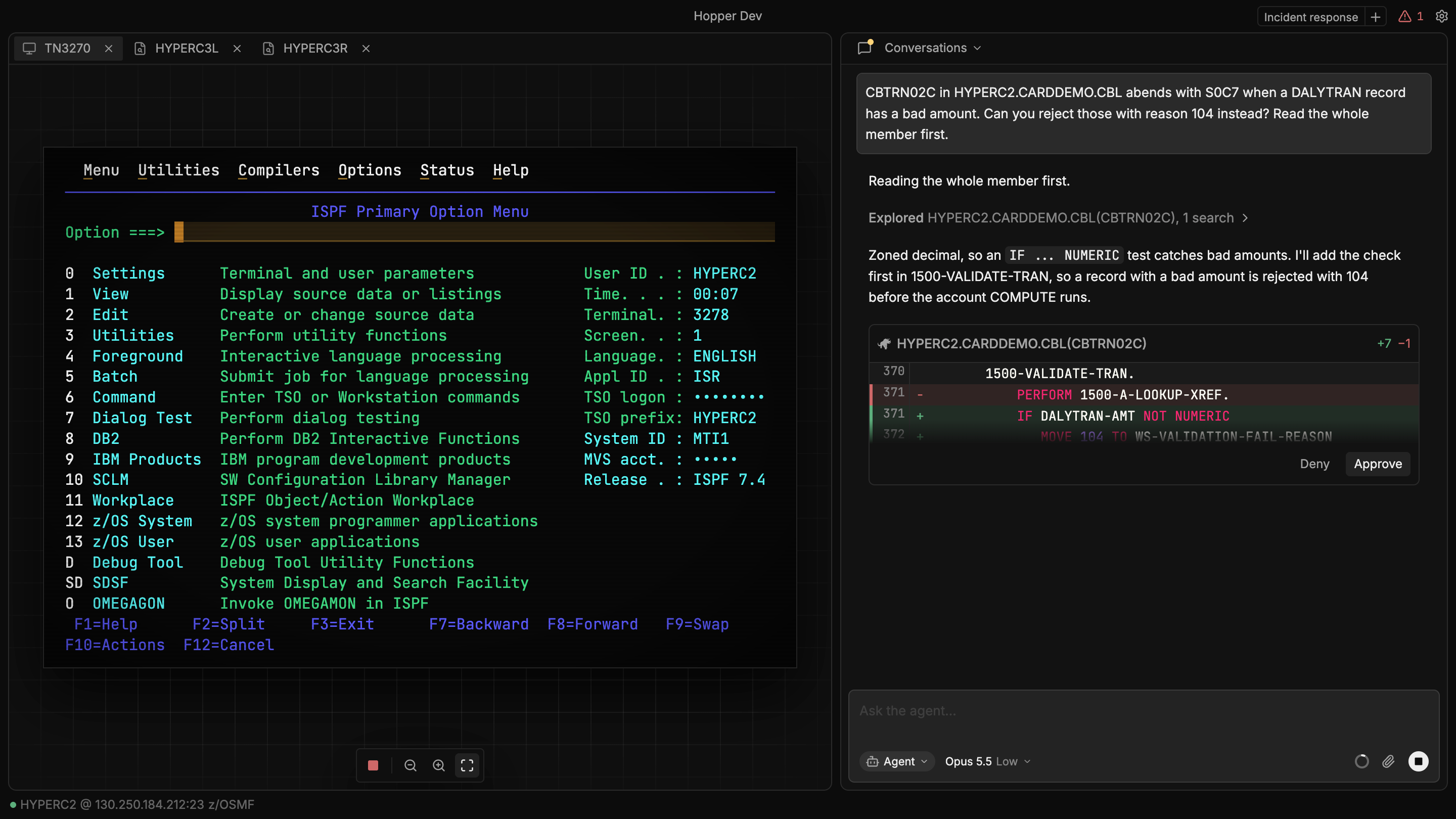
Building Hopper as a dedicated mainframe development environment lets us shape how the editor, host sessions, and agents work together. With 1.5, we’re taking that integration further: agents follow recent activity, pick up incidents with their supporting evidence, and present proposed changes for review in the same environment where engineers do their work.
1. Richer Development Context for Agents
Agents receive recent edits, host actions, and operation results as context for their next turn. Review proposed changes through diffs, JCL previews, and host-action cards, with separate permissions for local and mainframe work.
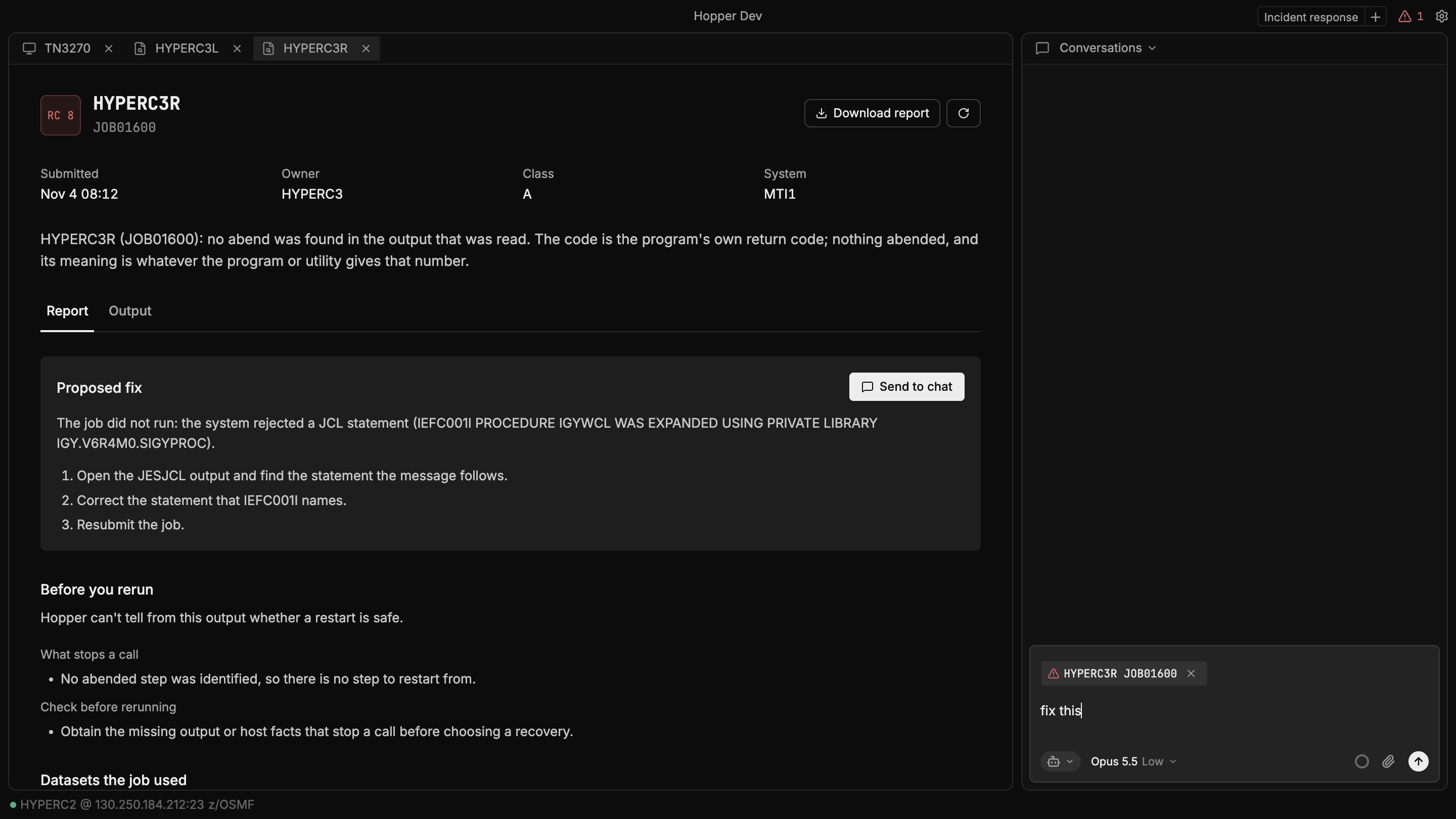
2. Automated Incident Detection and Failure Analysis
Hopper surfaces job failures and links incident reports to the host’s diagnostic evidence. Send an incident to an agent to investigate the cause and work through a fix.
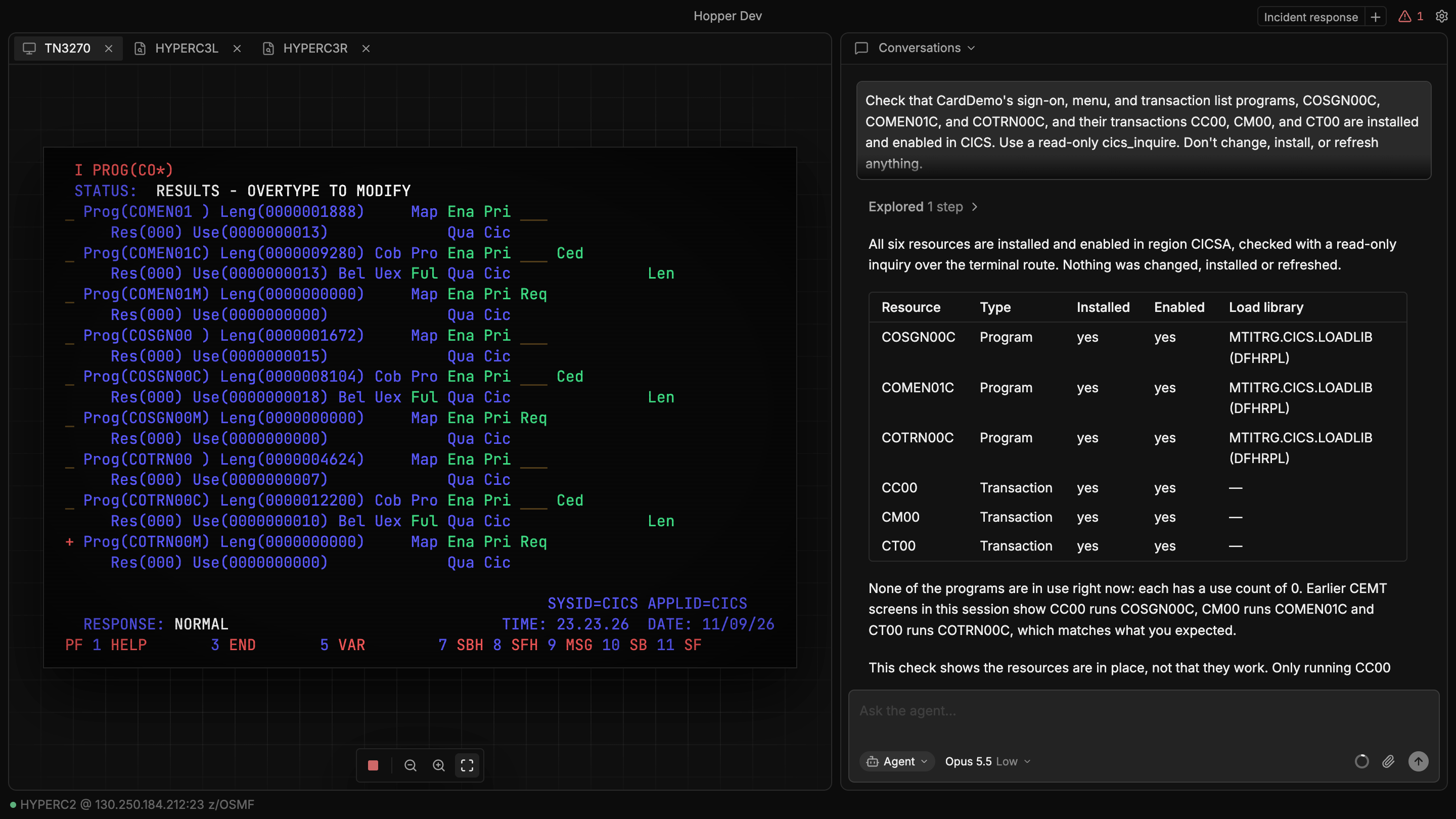
3. Agentic CICS Application Development
Work with agents to build COBOL programs and BMS maps, define and install resources, and refresh applications. Review cards show the target region and proposed commands before region changes run.
4. Built for Every Generation of Mainframe Engineers
Hopper meets engineers where they are. Experienced engineers keep the host session at the center, while newcomers can start from a familiar editor layout with an agent that helps them navigate the mainframe and investigate failed jobs. Rearrange panes, save your own layouts, and switch between them from the keyboard.
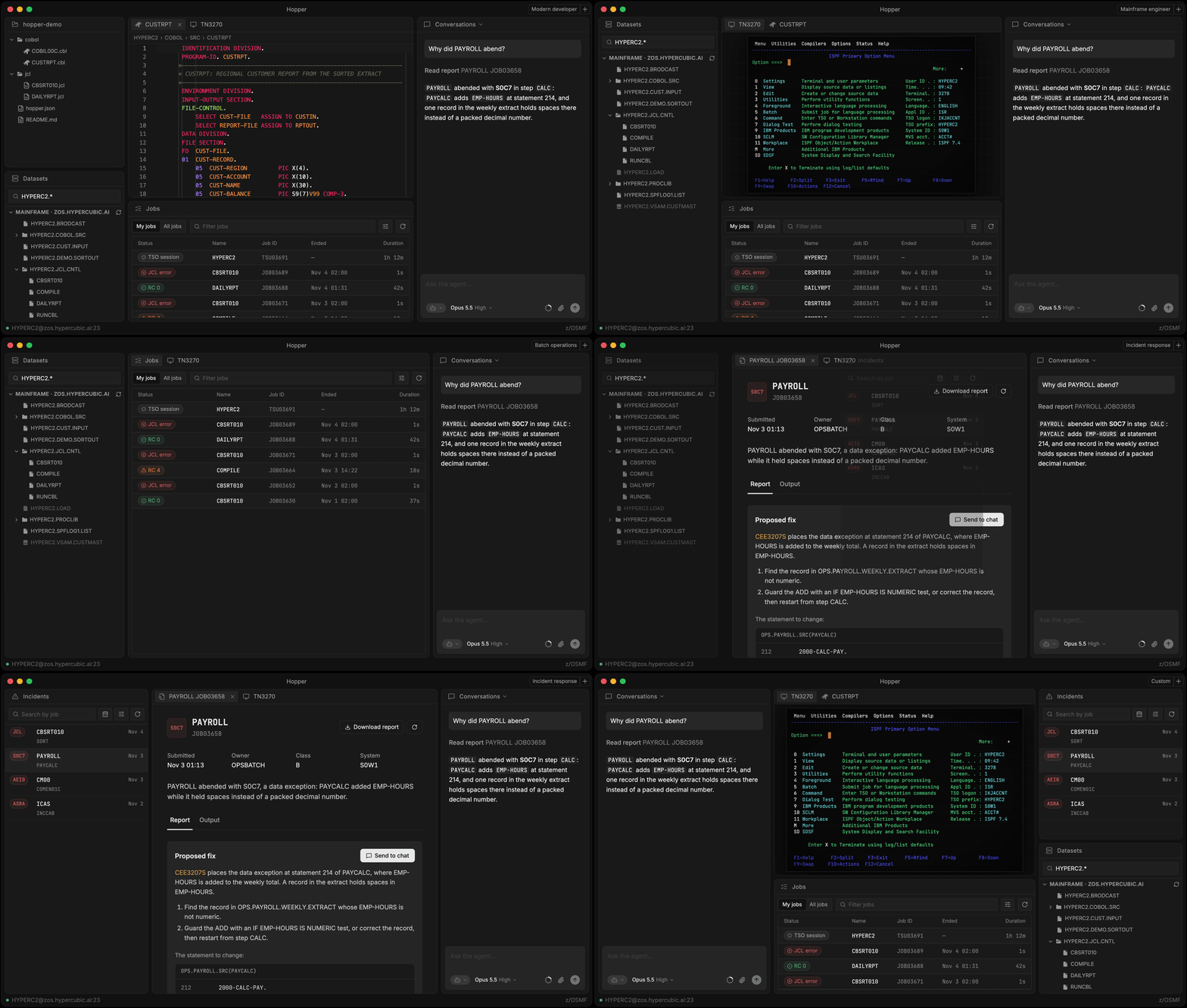
Toward Agentic Mainframe Engineering
The long-term opportunity goes well beyond accelerating individual development tasks.
Mainframe systems have accumulated decades of business logic, operational dependencies, and institutional knowledge. Maintaining them has traditionally required teams of highly specialized engineers who understand not only the code, but also the environments in which it runs.
As AI agents become more capable, more of that work can be performed through software.
But autonomy requires more than increasingly powerful models. Agents need access to the real system, visibility into execution behavior, and mechanisms for safely making and validating changes.
That is what we're building with Hopper.
The first release gave AI agents the ability to interact directly with mainframes. Hopper 1.5 brings those agents deeper into everyday engineering workflows, from development and debugging to incident investigation and CICS operations.
We believe the future of mainframe engineering will be built around small teams of engineers working alongside increasingly capable agents, with the ability to understand, operate, and maintain systems of extraordinary complexity.
Hopper 1.5 is another step toward making that future possible.
Download Hopper today.
Articles associés
Compréhension du code à l'échelle : apprendre de la leçon amère
Les astuces artisanales se brisent à l'échelle. L'avenir de la compréhension du code réside dans des systèmes holistiques fondés sur l'apprentissage.
L'effet Lindy et COBOL : pourquoi une langue vieille de 65 ans court dans le monde
On pourrait penser que des langues héritées comme COBOL meurent, mais elles ne vont nulle part.
Hypercubic Raises $5.3M to Build the Future of Mainframe Modernization
We’re announcing that Hypercubic has raised $5.3 million in seed funding, led by CIV.
HyperLoop: A Verification-Driven System for Mainframe Modernization
HyperLoop modernizes COBOL applications with AI and layered verification to preserve legacy behavior safely.